
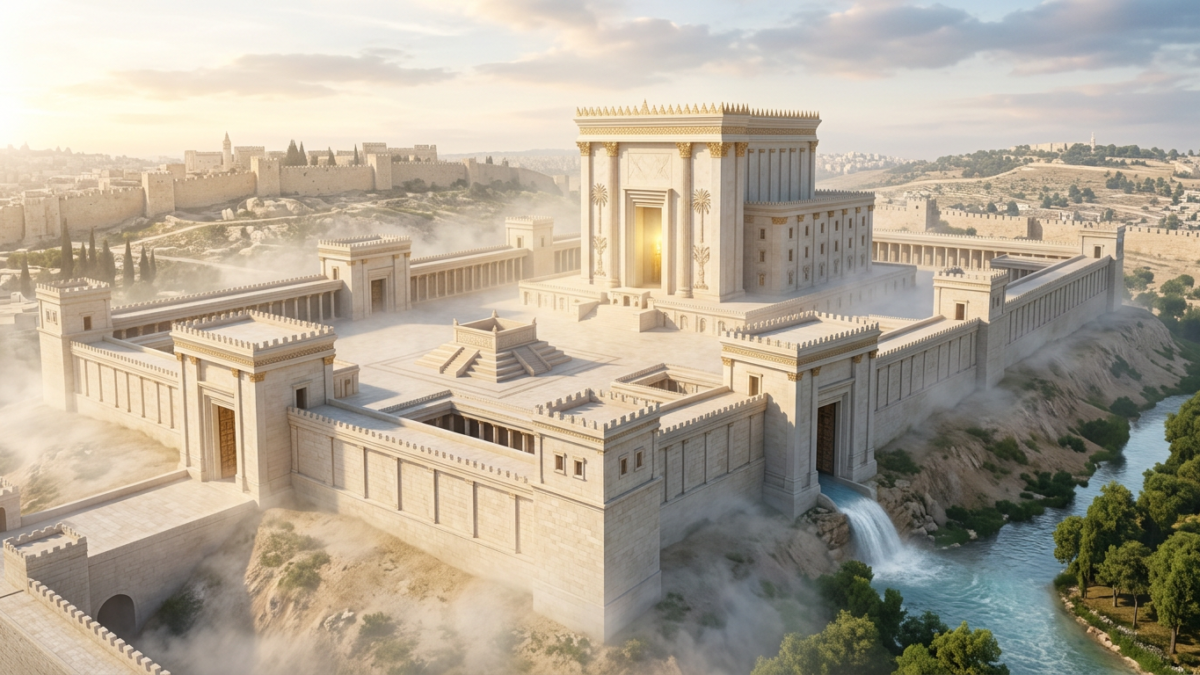

Enter with me into the Jewish world of first-century Jerusalem. I want us to try and understand the temple through the eyes of a Second Temple rabbi named Yeshua (Jesus) and his talmidim (disciples). They have spent the last couple of years walking the highways and byways of Galilee and the dusty streets of Jerusalem, speaking to one another in Aramaic—the everyday language of most Jews at the time—while sharing meals of flatbread, fish, olives, and figs. They kept the daily rhythms of Jewish prayer and gathered in the synagogue each Shabbat to hear Moses and the Prophets read aloud from Hebrew scrolls. And they regularly made their way to the magnificent temple that stood at the heart of Jerusalem, bringing their offerings and watching the priests carry out their sacred duties.
In the first century, the Jerusalem temple stood as the center of the Jewish universe. All roads led to the temple—theologically, socially, and culturally. The tabernacle/temple system commanded by Yahweh in the Torah was an ancient, sacred institution that had existed for nearly fiftten-hundred years.
As a Jew, the temple was where you brought your sacrifices. It was where atonement was made through the ministry of the Levitical priests. It was where you offered your sin offerings, guilt offerings, burnt offerings, peace offerings, and grain offerings. It was where you brought your firstfruits, completed your vows, and were cleansed from ritual impurity. After childbirth and certain illnesses, this is where you came.
Three times a year, you made the pilgrimage to Jerusalem for the feasts of Pesach, Shavuot, and Sukkot. You brought your Passover lamb to the temple and gathered there with the nation. This was where you prayed during the times of sacrifice, paid the temple tax, and participated in the religious life of Israel.
More than that, the temple was understood to be the place where heaven and earth met. In every meaningful way, it stood at the center of Jewish life.
The Prophetic End of the Temple
And it is against that backdrop that we arrive at one of the most startling moments in Christ’s ministry. One warm spring day in Jeruslem, Yeshua and His talmidim are in the temple. He teaches the parable of the tenants and answers questions about paying taxes to Caesar. He debates the Sadducees about the resurrection and teaches the two greatest commandments: love God and love your neighbor. And before leaving, He watches a poor widow place two small copper coins into the offering box, declaring that she has given more than anyone else because she gave from her poverty.
Then, as they were leaving the temple, one of Yeshua’s disciples marveled at its beauty and said, “Look, Teacher, what wonderful stones and what wonderful buildings!” (Mark 13:1).
Yeshua turns and looks up at the massive structure.
“Do you see these great buildings? There will not be left here one stone upon another that will not be thrown down.” (Mark 13:2)
What?
Put yourself in the disciples’ sandals for a moment. Imagine hearing your rabbi say such a thing. The magnificent temple that had stood for centuries—the very center of your faith and national life—was going to be destroyed? How many questions would immediately flood your mind?
When? Why? What do we do while the temple is gone?
As a Jew, you knew what the destruction of a temple meant. When the first temple was destroyed, it was God’s judgment on Israel for covenant unfaithfulness (Jer 25:8–11), and it was followed by exile from the land (2 Kgs 25:8–21). Yet God also promised that the temple would be rebuilt after seventy years—and it was (Jer 25; Dan 9).
So it’s not hard to imagine what may have been running through the disciples’ minds. Just a few days earlier, Jesus had wept over Jerusalem and declared,
“They will not leave one stone upon another in you, because you did not know the time of your visitation.” (Luke 19:44)
Jesus explicitly connected the coming destruction of Jerusalem and its temple to Israel’s failure to recognize their Messiah. So, now what? His disciples may have wondered if they, too, would be exiled from the land. Would a new temple eventually be rebuilt? If so, how long would they have to wait?
The questions must have been endless. Yet only one concern is recorded in Scripture. Mark’s Gospel tells us that as Jesus sat on the Mount of Olives overlooking the temple, Peter, James, John, and Andrew approached Him privately and asked:
“Tell us, when will these things be, and what will be the sign when all these things are about to be accomplished?” (Mark 13:4)
Their only recorded concern was when. They wanted to know how they could recognize the signs beforehand. Jesus responds by declaring that many will come in His name and deceive many, and that His disciples will hear of wars, rumors of wars, and uprisings (Mark 13:5–8; Luke 21:8–9). And, of course, we know from hindsight that the temple ultimately fell in AD 70, about forty years after Jesus predicted it.
Life Without a Temple
That such a momentous prophecy is followed by a single recorded question should at least give us pause. Knowing how central the temple was to Jewish life, it seems reasonable to assume that Jesus’ prophecy sparked a great deal of discussion among His disciples. Any first-century Jew would have found the subject deeply significant.
Yet the Gospel writers preserve no further discussion of the temple’s destruction—no additional questions, no extended conversations, no later attempts to clarify what life would look like without a temple. That doesn’t mean such conversations never took place, of course. It simply means the New Testament (NT) authors, writing under the inspiration of the Holy Spirit, chose not to include them. And for those of us who believe Scripture is the inspired Word of God, what the text leaves out is often as noteworthy as what it includes.
The Holy Spirit so guided the NT authors that the decisions they made as they wrote—the events and teachings they chose to include—were exactly what God intended. Which means the NT contains not only what its first readers needed to know, but what God intended believers in every generation to know.
And that brings us to a striking observation: Christ’s apocalyptic prophecy of the temple’s destruction produced no recorded questions about how faith in the Jewish Messiah would be practiced without a temple. There is no recorded anxiety, confusion, or debate among the disciples about what should happen if the temple were gone. Nor do the NT authors give instructions for adapting Christian worship to the absence of a temple. The issue simply never emerges as a concern.
The earliest years of the new covenant were a time of tremendous transition. Even before the temple fell, followers of Jesus were navigating a seismic shift in redemptive history. And unlike modern believers, they did not yet have an NT to consult. As the Gospels and apostolic writings were composed and distributed, they helped bring clarity to God’s people about Jesus, His gospel, and the meaning of the new covenant. And that makes the NT’s silence on one issue all the more remarkable.
Although Jesus plainly foretold the destruction of the temple, neither He nor the apostles ever direct believers to look forward to its rebuilding. There is no promise of a future temple, no instruction to prepare for its return, and no discussion of restoring the temple-centered system of worship. Instead, the NT consistently points believers to Christ as their epicenter of worship.
Think about that for a moment. The temple services, the high priest, the sacrifices, the altar, the bronze basin, the Most Holy Place, the bread of the Presence, the golden lampstand, the incense, the Levitical priesthood—all God-ordained under the Sinai Covenant—are not taught as part of following Jesus. In fact, Jesus told the Samaritan woman that the day was coming when worship would no longer be centered in Jerusalem, but would be offered in spirit and truth (John 4:21–24). Moreover, at the moment of His death, Yahweh Himself tore the temple veil that He had once required from top to bottom (Matt 27:51).
The Parting of the Ways
History bears this out. There is no historical evidence that the earliest Christians ever attempted to reconstruct a temple-centered theology or way of life. Rabbinic Judaism, by contrast, was forced to grapple with how the Torah could be observed without the temple. And understandably so. For centuries, faithfulness to the Sinai covenant had been expressed through rituals and practices that depended upon the existence of the sacred temple.
After the temple fell—and Jerusalem with it—the surviving Jewish religious leadership regrouped in the city of Yavneh. Faced with the loss of the temple and uncertain how long that loss would last, they began developing ways to preserve and adapt those aspects of Jewish life that had once revolved around it. They sought to maintain, as best they could, the commandments and practices God had given to Israel despite the absence of the temple God had destroyed.
Through remembrance, prayer, and adapted observances, they developed what later came to be known as zecher la-Mikdash—‘a remembrance of the temple.’ This helps explain why modern Judaism differs so significantly from the Judaism practiced by Jesus and the Jewish people of His day. In the absence of the temple, Judaism reorganized itself around the Torah. Torah and temple had always belonged together, of course. But before AD 70, Jewish life revolved around the Torah as it was lived out in the temple and its services. After the temple fell, however, Torah study and observance became the focal point of Jewish religious life.
Conversely, the early Christian church—which emerged during this same period and was itself largely Jewish—took a very different path, reconstituting itself around the person and work of Christ. The early church did not attempt to reconstruct a temple-centered faith or develop substitutes for the temple rituals commanded at Sinai. In fact, even while the temple still stood, the ecclesiology of the early church was being developed around elders (presbyteroi), overseers (episkopoi), and deacons (diakonoi) rather than priests and Levites (Acts 14:23; 20:17, 28; Titus 1:5–9).
Moreover, Jesus Himself declared that He is greater than the temple (Matt 12:6). Think about the weight of that statement. Even while the temple still stood in Jerusalem and remained the focal point of Jewish worship, Jesus claimed to be greater than the very institution God had established at the center of Israel’s covenant life.
The NT goes on to teach that those who are in Christ are now God’s temple (1 Cor 3:16; Eph 2:19–22), that all believers are priests (1 Pet 2:5, 9; Rev 1:6), that Christ’s sacrifice was final (Heb 9–10), and that no future offering for sin remains (Heb 10:18). We are even told explicitly that in the final state of things—in the new heavens and new earth—there will be no temple at all.
And I saw no temple in the city, for its temple is the Lord God the Almighty and the Lamb. (Rev 21:22)
Theologically, then, it makes sense that new covenant believers are not bound to the rituals and institutions of temple worship. Scripture teaches it plainly, and history confirms it.
Temple Expectations
With that background in mind, let’s now turn to the question before us: Will a third temple ever be built?
My own answer begins with a question: If a physical temple, the Levitical priesthood, and the Mosaic sacrificial system are no longer necessary for following Jesus, why would we expect a third temple to be built at all? What purpose would a new physical sanctuary serve?
None of the practices or institutions associated with the Mosaic temple are taught in Scripture as part of life under Christ. Nor will a new administration one day replace the one we are living under now and reintroduce the need for temple worship. Scripture says Jesus is enthroned forever, “far above all rule and authority and power and dominion…not only in this age but also in the one to come” (Eph 1:21), that “of his kingdom there will be no end” (Luke 1:33), and that “The kingdom of the world has become the kingdom of our Lord and of his Christ, and he shall reign forever and ever” (Rev 11:15).
From now until eternity, God’s people live under the reign of Jesus Christ. He will come again in glory to judge the living and the dead and bring His kingdom to its consummation, but His reign will not be replaced by something else. In fact, Revelation gives us a glimpse of the future in which people from every tribe, language, people, and nation are gathered not around a temple, but around the throne of God (Rev 7:9–17).
This raises a salient question: if a future temple is something Christians should expect, why is the NT silent on the issue? Jesus told His disciples that the Second Temple would be destroyed and—unlike the destruction of the first temple—offered no expectation that it would ever be restored. The NT as a whole offers no promise of a future temple, no instruction to prepare for one, and no expectation that the temple system will one day return. Instead, Jesus and the apostles consistently anchor the believer’s hope in Christ and the new creation.
Yet many sincere Christians do expect a future rebuilt temple. Why? I believe it’s because they prioritize certain Old Testament (OT) prophetic passages—especially those found in Ezekiel, Daniel, and Zechariah—and interpret them in a strictly literal and future-oriented way. The real question, as I see it, is one of biblical interpretation: Should these OT temple prophecies be prioritized over what the NT says? Or should they be read through the lens of what the NT says?
The Temple Through Christ
How do we harmonize those OT texts with the words of Jesus and the teachings of the apostles? The NT repeatedly explains that the temple, priesthood, and sacrificial system find their fulfillment in Christ (Matt 12:6; John 2:19–21; Heb 7–10). It teaches that believers are now God’s temple (1 Cor 3:16; Eph 2:19–22), that we are a royal priesthood offering spiritual sacrifices acceptable to God (1 Pet 2:5, 9), that “there is no longer any offering for sin” (Heb 10:18), and that in the new creation there will be no temple (Rev 21:22). How, then, are we to understand the expectation of a future physical temple?
It seems to me that the only way to maintain a strictly literal reading of these OT prophecies and expect a future physical temple is to assume that such a temple will be built in some future age as a temporary structure. I say “temporary” because, as we’ve seen, there will be no temple in the New Jerusalem (Rev 21:22). So if another temple is built, it will not last forever.
And that raises another important question: What purpose would such a temple serve?
Based on the NT witness, it is problematic to suggest that a future temporary temple would simply restore the functions of the earthly temple. As noted above, the NT repeatedly teaches that the institutions and practices associated with that temple are fulfilled in Christ. So a future temple must necessarily serve an entirely different purpose. Jesus declared that worship would no longer be centered in Jerusalem (John 4:21–24), and He identified Himself as the true and greater temple (Matt 12:6; John 2:19–21). Moreover, as we’ve seen, Christians are not only priests who have been given priestly duties (Rom 12:1; 1 Pet 2:5), but we’re also the temple of God (1 Cor 3:16). In light of those realities, it becomes difficult to see what role a lesser, temporary, physical temple would play now that Christ reigns on His throne.
I want to be careful not to overstate the case. The truth is that no one knows the future except God. Could a temporary temple be rebuilt at some point for purposes we do not presently understand? Perhaps. But I just don’t see a biblical warrant to expect such a development.
As a Christian, I believe the proper hermeneutical priority is to let Scripture interpret Scripture wherever possible. The NT authors should govern our understanding of OT prophecy, not the other way around. And because the apostles do not interpret Israel’s future hope as pointing to a restored temple system, but rather to Christ and the new creation, it seems to me that the OT temple visions are best understood typologically and Christologically.
They are true prophecies, of course. But rather than functioning as architectural blueprints for a future building project, I believe they are properly understood as employing the imagery and categories of the Sinai Covenant to communicate future realities that find their fulfillment in Christ: God dwelling with His people (Eph 2:19–22; Rev 21:3), the perfection of worship (John 4:21–24), and the fullness of redemption (Heb 9–10).
Therefore, because the NT consistently and explicitly grounds all of these realities in Christ and His church—and ultimately in the new heavens and new earth where God dwells with His redeemed creation (Eph 2:19–22; Rev 21:3)—expecting a literal third temple seems to me not only unnecessary, but at odds with the NT teachings of Christ and His apostles.


Thomas Garza
From God’s POV: I gave them the tent in the wilderness, two temples in Jerusalem and my “only begotten of the Father” and alas, none of them sufficed Israel. Now they clamor for a third temple. Should I invoke Einstein and his definition of insanity?
Anonymous
How do you explain these Messianic verses in Zechariah 6:12-13 referring to the coming Messiah the (Branch) prophecied to build the next Temple when He returns ?!
Anonymous
Christ and His people are the temple
Anonymous
Excellent essay! Very perceptive! (Just one little typo where the word “apocryphal” should be “apocalyptic”.)
R. L. Solberg
Thanks for catching that! For some reason, I often mentally swap those two terms.
RLS