

I like Rabbi Tovia Singer. He’s a winsome, intelligent, and charming man and a fabulous teacher. As my Jewish friends would say, he’s a mensch! I’ve not met him in person (yet), but I’ve watched a lot of his teachings online. One thing I love about his style is how he focuses his arguments like a laser beam on the fundamental issues of a topic. Rather than playing around with secondary issues, Singer grounds his argument to the bedrock premises. Because of that, his teachings have never failed to force me to dig deep and learn new things. And that’s exactly what he’s done with the passage I want to look at today. Singer recognizes Psalm 22:16 as a significant threat to Jewish theology because of its overtly Christological properties and has built his case against it on the two main pillars on which it rests: the accuracy of the English translation, and underneath that, the historical validity of the Septuagint.
In a new video (see below), Rabbi Singer begins building his case against a Christological interpretation of Psalm 22:16 by sharing a controversial theory. He claims that the Hebrews Scriptures were “raped” by the Christian Church in the second century:
The Jewish scriptures, the Hebrew bible—listen very carefully, this is going to be offensive—was raped—I selected that word—was raped by the Church. Not by these innocent, sweet Baptists from Arkansas. These young men and women have no idea this has been done. It was altered by the Church in order to make it appear Christological. This was done in the second century, a very long time ago.”
Rabbi Tovia Singer
As an example of this claim, Singer points to Psalm 22:16 (22:17 in Jewish bibles) which, in the King James Version says:
For dogs have compassed me: the assembly of the wicked have inclosed me: they pierced my hands and my feet.
According to Rabbi Singer, this interpretation is an intentional corruption of what the original Hebrew actually says.
The Hebrew Says…
In Psalm 22:16 the author, King David, is describing evil encircling him on every side. Singer points out that its the last three Hebrew words in this verse that are critical: ka’ari yadai v’ragelai. He then helps us define these Hebrew words:
- Ka’ari means “like a lion” (The word ari means “lion”)
- Yadai means “my hands”
- V’ragelai means “my feet”
Thus, says Singer, this phrase is properly translated, “Like a lion [at] my hands and my feet,” and not “they pierced my hands and feet.” Singer’s interpretation doesn’t seem unreasonable to me in context, but it reveals a troublesome discrepancy. Which is it, they pierced or like a lion? And how did we arrive at such different interpretations? Singer offers his theory:
“What did the Church do? It’s mind-blowing. Imagine you’ve got these words ‘like a lion my hands and my feet’ and you’ve got them in Microsoft Word. You select the words ‘like a lion’ so you now have white letters on a blue background. You tap your delete key, they disappear. And then you type in ‘they pierced.’ The text now is made to read ‘they pierced my hands and my feet.’”
Rabbi Tovia Singer
This somewhat scandalous claim leaves us with two important questions. First, what is the correct interpretation of this verse? Secondly, and more importantly, if there is a disagreement among translations, was it, as Singer charges, a willful “raping” of the original Hebrew text? If so, this would open a tremendous can of worms. We would need to ask what other passages in the Christian Old Testament (OT) are the product of textual corruption.
Scriptural data
Before we get too far down the road, I think it’s important to take a broad survey of the verse in question. Singer limits his protest to the King James Version of Psalm 22:16, which offers no footnotes or other commentary on its use of the word “pierced.” But the KJV was published in 1611. What do more modern translations say?
NIV
* Dead Sea Scrolls and some manuscripts of the Masoretic Text, Septuagint and Syriac; most manuscripts of the Masoretic Text me, / like a lion
“Dogs surround me, a pack of villains encircles me; they pierce* my hands and my feet.”
CSB
* Some Hb mss, LXX, Syr; other Hb mss read me; like a lion
“For dogs have surrounded me; a gang of evildoers has closed in on me; they pierced* my hands and my feet.”
ESV
* Some Hebrew manuscripts, Septuagint, Vulgate, Syriac; most Hebrew manuscripts like a lion [they are at] my hands and feet
“For dogs encompass me; a company of evildoers encircles me; they have pierced my hands and feet.*”
The newer translations above all acknowledge the alternate interpretations of the Hebrew source in their footnotes. So even if there was some sort of intentional mistranslation in the second century (as Singer asserts and I question), the proverbial cat has been let out of the bag; the record has been updated.
This made me curious whether the New King James Version (NKJV) would add anything to this verse, or leave the original interpretation unfootnoted, as the 1611 KJV did. The 130 translators that produced the NKJV (published in 1982) believed in faithfulness to the original Greek, Aramaic, and Hebrew texts including the Dead Sea Scrolls.1 And it turns out they, too, chose to acknowledge this issue in the new translation of this verse:
NKJV
* So with some Heb. mss., LXX, Syr., Vg.; MT Like a lion instead of They pierced
“For dogs have surrounded Me; The congregation of the wicked has enclosed Me. They* pierced My hands and My feet”
And what about Jewish translations of the Bible? How would they render this verse? It’s interesting that the Orthodox Jewish Bible does not mention the “lion” alternative:
OJB
“For kelavim have surrounded me; the Adat Mere’im (congregation of evil men) have enclosed me; ka’aru yadai v’ragelai (they pierced my hands and my feet; see Isa 53:5; Zech 12:10 and medieval Hebrew Scripture manuscripts as well as the Targum HaShivim)”
And the Complete Jewish Bible prefers the “lion” interpretation and puts the “pierced” reference in the footnote:
CJB
* Or: “They pierced my hands and feet.” See Introduction, Section VIII, paragraph 6, and Section XIV, footnote 70.
“Dogs are all around me, a pack of villains closes in on me like a lion [at] my hands and feet.*”
The Fine Art of Interpretation
There is a very interesting history behind the discrepancy in Psalm 22:16, and it’s not nearly as sinister as Rabbi Singer suggests. He claims that the difference between the two interpretations is the result of a willful “raping” of the Hebrew text by the Christian Church in the second century. He even provided a clever Microsoft Word analogy in which the original text “like a lion” was highlighted and deleted, and then the new, unrelated text “they pierced” was typed in its place with the intention of changing the meaning of the original text.
In actuality (and I would be surprised if the Hebrew-speaking Rabbi Singer did not know this), the difference between the phrases like a lion and they pierced in Hebrew is a single letter. In Hebrew, the phrase “like a lion” is ka’ari, as Singer pointed out, while the phrase “they have pierced” is ka’aru. These two words are nearly identical. The only difference is that ka’ari (lion) ends with the Hebrew letter yod, and ka’aru (pierced) ends with the Hebrew letter vav.
Using Singer’s Microsoft Word analogy, this looks a lot more like a typo than a deceitful edit. But of course, ancient translators did not use word processors. They were writing by hand and it turns out that the difference between a vav and a yod is slight:
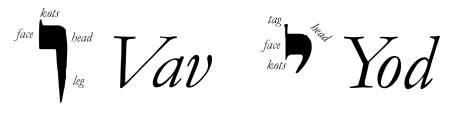
As you can see in the image above, the letters are very similar in shape. This hardly seems a case of highlighting a phrase, deleting it, and re-typing something completely different. Its more akin to someone writing the English word “major” in cursive, and someone else, hundreds of years later, accidentally reading it as “mayor.” And given the alternate modern translations of this text that we looked at above, it seems to me much more plausible that what we see in Psalm 22:16 is the result of a scribal error, rather than the product of malicious editing for theological purposes.
The Way Back Machine
Unfortunately, we can’t check whether this word was supposed to be a vav or a yod because we do not have access to the original Hebrew text. There are two primary early sources; the Masoretic Text,4 which is universally accepted as the authentic Hebrew Bible and translates the Hebrew phrase in Psalm 22 as “like a lion,” and the collection of Greek texts known as the Septuagint,5 which render the phrase in question as “they pierced.”
Rabbi Singer makes the point that, although the original Septuagint translation dates to two centuries before Christ, that version only contained the first five books of the Bible. He claims that the Psalms were not translated until the second century after Christ. Therefore, concludes Singer, the men who translated Psalm 22 into Greek as part of the Septuagint would have been motivated to (and, in fact, did) edit the text to make it more Christological.
There is debate as to just how much of the Hebrew Bible had been translated into Greek by the time of Christ. And, interestingly, the Masoretic text is even more open to Singer’s charge of biased translation. Since work on the Masoretic text did not even start until the 6th century after Christ,6 one could argue that the Jewish scribes of the Masoretic texts were motivated to interpret Psalm 22 in a way that would render it less Christological.
To be clear, I’m not making that claim personally. I don’t know enough about the history of the Masoretic text’s translation of Psalm 22 to make so bold a statement. What I’m pointing out is that if both historical sources came after Christ, trying to determine the proper interpretation of Psalm 22:16 based on the historical relationship between the translation and the time of Christ is ineffective. In fact, history would seem to favor the Septuagint since it is hundreds of years closer to the original texts. As for religious bias, that too favors the Septuagint; many of the scribes that worked on the Septuagint translation were Jewish, whereas there were no Christians (as far as we know) who participated in the development of the Masoretic text.
Context is King
There is one last issue to consider when seeking the proper interpretation of Psalm 22:16, which is the context of the psalm in which the verse appears. When we consider the totality of Psalm 22, what is it telling or teaching us? When read in its entirety, one can’t help but notice the striking connection to the crucifixion of Jesus. Rabbi Singer naturally insists that, rather than containing prophecy, Psalm 22 is merely a present-tense Psalm written by King David about himself. Because of his rejection of Jesus as the Messiah, Singer is predisposed to such an interpretation. But on closer examination, I believe the scriptural evidence shows that this is, indeed, a Messianic psalm.
First of all, it’s opening lines—”My God, my God, why have you forsaken me?” (Ps 22:1a)—are the very words that Christ uttered on the Cross:
About three in the afternoon Jesus cried out in a loud voice, “Eli, Eli, lema sabachthani?” (which means “My God, my God, why have you forsaken me?”).
Matt 27:46 (See also: Mark 15:34)
Some believe that Jesus’ quoting of Psalm 22 was a visceral expression that came to His lips because of His deep familiarity with Psalms. That seems plausible to me. But I also believe, because He was so near the completion of the very mission for which He was sent, that Jesus measured His final words carefully and was quoting Psalm 22 to highlight its Messianic nature. There are a number of other passages in Psalm 22 that suggest it is a prophecy that was fulfilled by Jesus.
| Psalm 22 Prophecy | New Testament Fulfillment |
|---|---|
| “All who see me mock me; they hurl insults, shaking their heads. ‘He trusts in the LORD,’ they say, ‘let the LORD rescue him.’” -Psalm 22:7-8 | “The people stood watching, and the rulers even sneered at him. They said, “He saved others; let him save himself if he is God’s Messiah, the Chosen One.” The soldiers also came up and mocked him. They offered him wine vinegar and said, “If you are the king of the Jews, save yourself.” There was a written notice above him, which read: this is the king of the jews. One of the criminals who hung there hurled insults at him: “Aren’t you the Messiah? Save yourself and us!” -Luke 23:35-39 (See also Matt 27:39-44) |
| All my bones are on display; people stare and gloat over me. They divide my clothes among them and cast lots for my garment.” -Psalm 22:17-18 | “Let’s not tear it,” they said to one another. “Let’s decide by lot who will get it.” This happened that the scripture might be fulfilled that said, “They divided my clothes among them and cast lots for my garment.” So this is what the soldiers did.” -John 19:24 (See also: Matt 27:35, Mark 15:24, and Luke 23:34) |
| My mouth is dried up like a potsherd, and my tongue sticks to the roof of my mouth;” -Psalm 22:15a | “Later, knowing that everything had now been finished, and so that Scripture would be fulfilled, Jesus said, “I am thirsty.” -John 19:28 |
There is also the phrase at the end of verse 15 that says, “You lay me in the dust of death.” Neither poetry nor prophetic literature should be pressed too hard for a literal interpretation, of course. But if this is a Messianic psalm, this phrase could be referring to someone who will literally die and be buried. This is a reasonable inference since, in verse 29, we see the phrase “go down to the dust” paralleled with “cannot keep themselves alive,” indicating that the author is using the phrase to indicate physical death.
Another clue that this could be a Messianic psalm comes near the end. After writing about God’s deliverance from suffering, King David concludes:
The poor will eat and be satisfied;
Psalm 22:26-27
those who seek the Lord will praise him—
may your hearts live forever!
All the ends of the earth
will remember and turn to the Lord,
and all the families of the nations
will bow down before him
If David were referring to himself, this passage would seem to imply that David’s own suffering will cause all the families of the nations to bow down and worship God. But that doesn’t seem to be the case. David’s suffering has not led to such an outcome among all the nations. The suffering of Jesus, on the other hand, has. People in every nation are coming to God through His work on the cross.
Moreover, theologian John MacArthur notes that Psalm 22, “was applied immediately to David and ultimately to the Greater David, Messiah. The NT contains 15 messianic quotations of or allusions to this psalm, leading some in the early church to label it ‘the fifth gospel.’” And the author of the NIV commentary tells us:
“No other psalm fitted quite so aptly the circumstances of Jesus at his crucifixion. Hence on the cross, he quoted from it (see Mt 27:46 and parallels), and the Gospel writers, especially Matthew and John, frequently alluded to it (as they did to Ps 69) in their accounts of Christ’s passion (Matt 27:35, 39, 43; John 19:23–24, 28). They saw in the passion of Jesus the fulfillment of this cry of the righteous sufferer. The author of Hebrews placed the words of v. 22 on Jesus’ lips (see Heb 2:12 and note). No psalm is quoted more frequently in the NT.”
Some may argue that the Psalms are not intended as prophetic literature. But that is not so. Theologian Luke Wayne explains:
“King David commissioned a group of priestly musicians who were “to prophesy with lyres, harps, and cymbals,” (1 Chronicles 25:1). Among them was the household of Asaph who wrote 12 of the Psalms, Heman who wrote another, and Jeduthan who was involved in the composition of three. They were commissioned to prophesy through music, and from that came biblical Psalms. There is no contradiction between being a Psalm and being prophecy. Indeed, there is an important, positive relationship between the two . . . This being the case, it is clear that Psalms can and do point forward prophetically to future fulfillments, at least sometimes messianic fulfillments.”
Summary
It strikes me as odd that the early church translators would swap out the phrase “like a lion” for the phrase “they pierced” in verse 16, yet leave the other Messianic passages from Psalm 22 intact. Rather than malfeasance on the part of early Christian translators, I believe the weight of the evidence suggests a scribal error is at the root of this discrepancy. Thus, the way most modern translations acknowledge the alternate interpretations of this verse in the footnote is appropriate.
So which interpretation is correct? In the end, whether we interpret it pierce or lion does not really matter in terms of the overall scriptural case for Jesus’ Messiahship. There are hundreds of other passages and prophecies that reveal His messianic attributes, so the Christian case does not stand or fall based on Psalm 22:16. Personally, I think either interpretation fits the context of the psalm as a whole. And on that note, I will leave you with a compelling point made by Dr. Michael Brown (whose doctorate is in Near Eastern languages and literature), who notes:
“But let’s assume the correct translation is, ‘Like a lion at my hands and feet.’ What is the lion doing with the victim’s hands and feet—licking them? The renowned Jewish commentator Rashi says it means ‘as though they are crushed in a lion’s mouth.’ So the imagery is clear: the metaphorical lions are tearing and ripping at the sufferer’s hands and feet. This mauling and biting graphically portrays great physical agony. It’s entirely consistent with what occurs in a crucifixion. So either translation could be said to foreshadow the suffering of the Messiah.”7
- Prophecy: The Messiah must be seen by Israel as pierced
- Source in the Tanakh: Zechariah 12:10; Psalm 22:17(16)
- Fulfillment in the B’rit Hadashah: Luke 24:39; Yochanan 19:34-37; Revelation 1:7


Let Us Reason
Hi Rob, thank you for this article! I just wanted to comment on your mention of Tovia’s claim about the Psalms in the Septuagint not being translated until after Christ. That sounds wildly incorrect to me. Yes, we have reason to believe that the Torah was translated first, but it is believed that the rest of the Tanakh was translated over the next hundred years at most. This is even stated in Encyclopedia Britannica under “Septuagint.” Also, when New Testament authors quoted Psalms, would they be quoting the Septuagint? Since we know the NT was written within the 1st century, if they were quoting the Septuagint when they quoted Psalms, that is evidence that it was already written by the time of Christ. One example that immediately pops to mind is Hebrews 10:5 quoting Psalm 40:6. The author of Hebrews quotes Psalm 40:6, and in this quote, he includes “but a body thou hast prepared for me.” But when we look at our Masoretic Text-derived Old Testament’s, we do not find that. However, the Septuagint does align with this quotation from Hebrews. That would seem to me to be evidence that the entire Septuagint was indeed well finished by the time of Christ and the apostles, since they are quoting it.
R. L. Solberg
Thanks, Mike! I agree we have good reason to believe that by the first century, it was more than just the Torah that had been translated into Greek. Happy Easter to you!
Arkady
I was recently researching this topic, coincidentally because I wanted to check Tovia’s claim (he made it again on November 2022). Not only does the LXX have a verb (pierced/dug), but so does the DSS and the Targum. Of course, these several communities would have had no reason to conspire together to make up a verb, let alone the same (or very similar) one.
So the outlier is the MT. It seems most plausible to me that the original text had a verb, whence the LXX, DSS, and Targum, but that verb was Microsoft Worded out of the MT because it was so clearly Messianic.
Yosef
The Dead Sea scrolls do not say pierced. Period.
Anonymous
I’m sorry. I feel people ARE being purposefully obtuse. This psalm has constant lion references in it and translating the word as lion seems obvious based on the theme. the person who claimed the Targum had translated it a verb is lying or confused. Look three verses earlier (14) to see a verse that is clearly speaking about a lion and the Targum translates it the exact same way. Be proud of who you are and take the “L”. Stop forcing Christianity in places where it clearly didn’t exist.
R. L. Solberg
Thanks, Anonymous. As I said in the article, “So which interpretation is correct? In the end, whether we interpret it pierce or lion does not really matter in terms of the overall scriptural case for Jesus’ Messiahship. There are hundreds of other passages and prophecies that reveal His messianic attributes, so the Christian case does not stand or fall based on Psalm 22:16. Personally, I think either interpretation fits the context of the psalm as a whole. “
Anonymous
Psalm 22 has nothing to do with Jesus but why did you bother to raise it as a point?
There is no question that psalm 22:17 says “like a lion.” None whatsoever. The translation “pierced” is totally spurious.
When examined academically none of the proof-texts hold much water. Dr. Solberg, I understand that you are a Biblical scholar and I implore you to use the rigorous scientific methods that I am sure you are familiar with to examine these texts.
I am more than happy to engage with you on this and other issues.
Respectfully,
Yosi
Tom
Solberg says: “One example that immediately pops to mind is Hebrews 10:5 quoting Psalm 40:6. The author of Hebrews quotes Psalm 40:6, and in this quote, he includes “but a body thou hast prepared for me.” But when we look at our Masoretic Text-derived Old Testament’s, we do not find that. However, the Septuagint does align with this quotation from Hebrews. That would seem to me to be evidence that the entire Septuagint was indeed well finished by the time of Christ and the apostles, since they are quoting it.”
———Mr. Solberg, I will argue that I can be reasonable to accuse the NT author of taking Psalm 40 out of context, and if you disagree, I’d like to know precisely where my argument starts becoming “unreasonable”:
First, if a Trinitarian Protestant gets something wrong in the bible, would you automatically accuse them of any degree of unreasonableness? Must it always be that they got it wrong because they didn’t pray enough about it, or if they did, they had unconfessed sin, or if none, they must not have been as open to possible correction as God wanted them to be? Or would you agree with me that sometimes, truth is so hidden and ambiguous, you can’t always legitimately fault somebody for misconstruing it, and they could possibly have been reasonable to hold a theory or interpretation, at least until they found out it was false?
Second, is the evidence for the Hebrews 10:5 rendering of Psalm 40:6 as existing in a pre-Christian Lxx manuscript so compelling that only fools would deny it? Or is the theory of the pre-Christian existence of that particular version of Psalm 40:6 sufficiently indirect that it might be reasonable to disagree with it? I mean, it isn’t like you can find a clearly Lxx manuscript of Psalm 40:6 that is clearly dated to before the 1st century, which has “but a body you have prepared for me”. That theory involves key assumptions that are less than “clearly” established.
Third, Christian scholarship is unanimous in admitting that the NT authors did not limit their interpretive criteria solely to the grammatico-historical method. But the only reason Hebrews 10:5 presents a “problem” to modern Christian scholars is because it cannot possibly have been an emergent property of the grammatico-historical method! You employ the grammatico-historical method on the scriptures all the time. You wouldn’t be caught dead giving a Greek translation of Psalm 137:9 that differs from the Hebrew as dramatically as Hebrews 10:5’s Greek translation differs from the Hebrew of Psalm 40:6. And if you defended any such thing by saying “I was merely trying to bring out a messianic prophecy that nobody had seen there before, just like in the case of Paul and Psalm 40:6” (we’ll assume Paul wrote Hebrews 10:5) , you would be scorned to death by your own favorite Christian scholars. Your violation of the grammatico-historical method would be considered final definitive proof that you erred, case closed.
Fourth, we all know that a mere possibility cannot, alone, suffice to function as an increase in probability. The fact that it is POSSIBLE that the NT author thought the Hebrew “my ears you have pierced” was synecdoche and necessarily implied the entire body in submission to God’s will, does not do anything to increase the probability that synecdoche, i.e., “ear = body” is in fact what the NT author had in mind. Can we be reasonable to say the mere supposition of synecdoche, without more, imposes no obligation on a non-inerrantist to view it as the likely correct solution?
Fifth, the immediate context of Hebrews 10:5 discloses that the author thought Psalm 40:6 was something spoken by Jesus to God the Father at the time the Psalm was composed (David, 900 b.c.). That’s a problem because nothing in Psalm 40 expresses or implies that any portion of it was something some sort of “Word” separate from yet equal to the “Father” was talking to the Father.
Sixth, if you are so quick to cite the bias of the Jehovah’s Witnesses against the deity of Christ as at least a partial explanation for why they throw that unjustified “a” into the third clause of John 1:1 to get away from Jesus being God…we have to wonder why you aren’t as quick to similarly accuse Paul of having such a strong bias in favor of Jesus’ pre-existence, that this was some of the reason he took a Psalm (which nobody ever suspected revealed what the messiah said to God the Father during some incarnation), and rendered it in a way that made the Psalm support exactly that.
Seventh, you will blame your always favoring Paul, upon your presumption that Paul was inspired by God to render the Psalm the specific way that he did. But I do not ask whether YOU can be reasonable. I ask whether the non-Christian can be reasonable to disagree with you here: Can they possibly be reasonable to be suspicious that your imperfect religious bias is the primary reason you give Paul more breaks than you’d ever give anybody else who rendered the Hebrew OT into Greek in such an unexpected way that departs so substantially from the grammatico-historical method? Or is Paul’s divinely inspired infallibility so utterly clear and compelling that only unreasonable people could possibly question it?
Eighth, if we think the reason why extant manuscripts of LxxPsalm 40:6 have soma/body at Psalm 40:6 is because the Christian copyists who wrote those manuscripts, knew about the different rendering in Hebrews 10:5, and, being Christians, naturally assumed that the apostle’s unique rendering of the Psalmic verse was a more reliable witness to the original text of that verse, and thus copy-and-pasted the NT rendering back into their copy of Psalm 40…could we be reasonable to think that? After all, some Christian scholars think it probable that the extant Psalm manuscripts containing “but a body you have prepared for me” are indeed a case of backward transposition by Christian scribes who naturally thought the apostle knew the original text better than the manuscripts the copyists had to work:
“Although it is true that LXX B S A have sōma, these probably should be read as corrections by scribes wishing to bring the manuscripts in line with Hebrews’ quotation.”
George H. Guthrie, “Hebrews” in G.K. Beale, D.A. Carson, eds., Commentary on the Use of the Old Testament in the New Testament (Baker Academic, 2007), p. 517, 604
Some Christian scholars are objective enough to admit the harsh truth despite their love of the bible initially inclining them to make only inerrancy-friendly remarks:
“The citation of Psalm 40 is an instance…in which the Psalm’s fundamental thrust and content has been changed. The adaptations made to Psalm 40 are relatively extensive. Thus it is given as an extreme example of fluid recontextualization, as it is poured into a bottle of a very different shape.”
Rev. Dr Thomas Ladd Blackstone, “The Hermeneutics of Recontextualization in the Epistle to the Hebrews” (PhD diss., Emory University, 1995), pp. 159–60.
Paul Ellingworth was an Honorary Professor in New Testament at the School of Divinity, History & Philosophy of the University of Aberdeen and Edinburgh and was former translation consultant for the United Bible Societies. He wrote A Translator’s Handbook on Paul’s First Epistle of Paul to the Corinthians (1985) with H. Hatton and A Translator’s Handbook on the Letter to the Hebrews (1983) with Eugene A. Nida. Of his Epistle to the Hebrews scholarly commentary, the publisher says “In his determined quest to understand Hebrews, Ellingworth begins with a detailed study of the Greek text, working outward to consider the wider context, linguistic questions, and the relation of Hebrews to other early Christian writings and to the Old Testament. Nonbiblical writings such as Philo and the Dead Sea Scrolls, though less directly related to Hebrews, are considered where appropriate.” Catholic Biblical Quarterly said of it “”The meticulousity, fairness, and good judgment with which philology, textual criticism, relevant biblical and nonbiblical texts, and secondary literature are brought to bear on Hebrews is impressive. This work joins the list of the other excellent commentaries on Hebrews which have been published in recent years, but it carves a niche all its own.”
In his commentary, Ellingworth says the author of Hebrews:
“…leaves the meaning of the psalm behind…Given the apparent lack of any earlier messianic understanding of this psalm, the basis for Hebrews’ interpretation can only be the historic event of the death of Jesus, interacting creatively with the author’s own preoccupation with the themes of priesthood and sacrifice…” Epistle to the Hebrews,
pp. 505–6.
“This extension of the meaning of the claim that God did not want sacrifice, actually reverses the meaning of the OT passage for our author…”
Steven K. Stanley, 1994 PhD thesis, A New Covenant Hermeneutic: The Use of Scripture in Hebrews 8-10, p. 173.
Ninth, there is no compelling reason to pretend that Paul must have been honest in his exegesis here because he would have realized the looming threat of being exposed if he had unfairly manipulated the OT to derive something not present in the text. No such threat existed, so if he kept on the straight and narrow, it was not due to any fear that dishonest translation would be exposed: First, 1st century people were largely illiterate, so Paul’s intended audience for Hebrews were likely illiterate and for this reason were far less likely to catch the textual problem than literate people would. Second, there is nothing in the NT expressing or implying that God wanted illiterate Christians to learn how to read, so you cannot even argue that Paul would have feared some in his target audience would learn to read and discover this textual enigma. Third, scholars cannot decide whether the recipients of “Hebrews” were Christian or non-Christian Jews. So there is a possibility they were Christian Jews, which creates a possibility that they previously decided Paul or the author of Hebrews was inspired by God to handle the OT however he did…which then would mean they wouldn’t raise a ruckus about his handling of Psalm 40:6 even if in their private judgment they felt something was amiss. Fourth, there is no reason to think Paul would carefully avoid error in his Christological exegesis even assuming Hebrews was written to non-Christian Jews: Paul had a cult-leader mentality that presumed to disagree with him was to disagree with God. If any Hebrew came back to him and complained about Hebrews 10:5 misrepresenting Psalm 40:6, Paul would have likely responded in a manner consistent with his responses found elsewhere in the NT “God chose me to reveal not clear things, but mysteries” (Romans 16:25-26); “you don’t properly appreciate my insight into the mystery of Christ” (Ephesians 3:3); “I will warn you this time to stop disagreeing with me. You only get one more warning, after that, you are a heretic, and I will prohibit further interaction with me” (Titus 3:9-11); “I tell other people to refrain from wrangling words because it is useless and leads to the ruin of the hearers, and your remarks about the difference between “my ears you have pierced” and “but a body you have prepared for me” constitute the forbidden word-wrangling” (2nd Timothy 2:14); “You are factious for disagreeing with me, and I’ve previously labeled trouble-makers like you as perverted and is sinning, being self-condemned” (Titus 3:9-11); “you are conceited and understand nothing; you have a morbid interest in controversial questions and disputes about words, out of which arise envy, strife, abusive language, evil suspicions, results that I obviously prohibit” (1 Timothy. 6:4); “I think I have the spirit of God” (1st Cor. 7:40); and finally “when you received the word of God which you heard from us, you should have accepted it not as the word of men, but for what it really is, the word of God.” (1 Thess. 2:13).
Tenth, “The writer understands the cited passage as a word addressed by the Son to the Father on the occasion of the incarnation, which the psalmist, as it were, overheard (Lane, W. L. (2002). Vol. 47B: Word Biblical Commentary : Hebrews 9-13, p. 263). I do not ask whether from within your Inerrantist/Christian perspective, Paul’s handling of the text can be excused. The answer to that is manifest. Instead, I ask whether you think a non-Christian could possibly find this Jesus-talking-incarnation-through-somebody-else-900-years-before-the-incarnation stuff too bizarre to justify scholarly level consideration.
Don’t these ten arguments provide a reasonable basis (even if also an imperfect fallible basis) for non-Christians to accuse Paul of taking Psalm 40:6 out of context?